

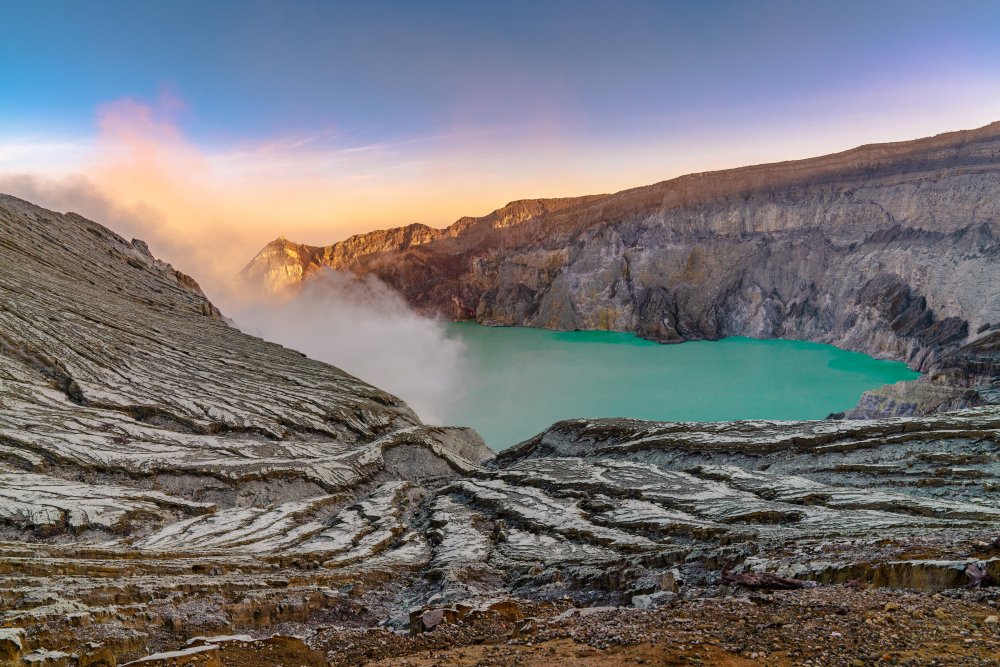
Search for “blue fire volcano” and two names keep coming up: Ijen in Indonesia and Dallol in Ethiopia. Many tour sites say these are the only two places on Earth with blue fire. Catchy, but not quite true.
This guide puts the two side by side: the science, getting there, climate, cost and safety. Only one of them works for a normal holiday in 2026.
Ijen vs Dallol at a Glance
- Ijen: East Java, Indonesia. Blue fire on most nights, reached by a night hike.
- Dallol: Afar region, Ethiopia. Rare, unpredictable flames in one of the hottest places on Earth.
- 2026 status: Ijen is open again after a forest fire closure. Western governments warn against travel to Afar.
Where the “Only Two in the World” Claim Comes From
The idea traces back to photographer Olivier Grunewald. His night shots made Ijen’s blue fire famous, and he also photographed a blue glow at Dallol in Ethiopia’s Danakil Depression. Two places, one photographer, and a myth was born.
Blue sulfur flames have appeared elsewhere too. Wildfires in Yellowstone National Park have set the sulfur around hot springs alight. There are also accounts from Costa Rica’s Turrialba volcano and from Mount St. Helens before its 1980 eruption. What makes Ijen special is consistency. Volcano experts describe it as the only known site that has burned blue for centuries, while Dallol’s flames only show up when conditions are just right.
The Science Behind Blue Flames
Neither volcano has blue lava. Ijen’s real lava is the usual red-orange. What you see is burning sulfur.
Sulfuric gas from the crater rises, meets oxygen at the surface and ignites with a blue flame. Some of the gas condenses into liquid sulfur that keeps burning as it flows, which creates the “rivers” you see in photos. At Ijen, the flames can leap up to 5 metres. They only show in darkness, so every Ijen hike starts after midnight.

Ijen vs Dallol: Getting There
Ijen is easy to reach. Fly to Banyuwangi, or cross from Bali by ferry. From Banyuwangi it is about 1.5 to 2 hours by car to Paltuding, the trailhead, followed by a hike of roughly 3 km to the rim.
Dallol is another story. Tours usually start in Mekele or Semera and drive into the Danakil Depression by 4×4 convoy. In 2026, civilian flights to and from Tigray (where Mekele is) have been suspended since 29 January, and foreign nationals currently cannot use airports in Afar. The US advises against all travel to the Afar region, and Canada says the same.
| Feature | Ijen (Indonesia) | Dallol (Ethiopia) |
|---|---|---|
| Location | Banyuwangi and Bondowoso, East Java | Danakil Depression, Afar region, near the Eritrean border |
| Elevation | About 2,386 m at the summit | More than 100 m below sea level |
| Nearest airport | Banyuwangi, or Bali plus a ferry | Mekele or Semera (no access for foreign travelers in 2026) |
| Trip length | One night from Banyuwangi, two days from Bali | 2 to 4 days by 4×4, plus flights via Addis Ababa |
| Best season | April to October (dry season) | November to March (cooler months) |
| How you see the blue | Night hike to the crater floor, most nights | Rare and unpredictable; tours mostly visit by day for the coloured springs |
| Guide required | Strongly recommended | Yes, organised tour with local guides and security escort |
Climate and Physical Difficulty
Ijen is a cold, steep night hike. The first hour is the toughest, and the rim can feel close to freezing before dawn. You also face sulfur gas on the crater floor, so a gas mask is essential, and a guided kawah ijen trek usually provides one along with a head torch.
Dallol sits more than 100 metres below sea level in one of the hottest places on Earth. The walks are short, but heat, acidic pools and fragile salt crust make them draining.

Cost and Permits
Ijen is cheap by comparison. The entrance ticket for foreign visitors is Rp150,000, plus a small insurance fee. Tickets can be booked online through the official AyoKeTamanNasional platform. The park also closes once a month for its Ijen Rijik clean-up day, including 4 December 2026, so check dates before you book.
Most travelers skip the paperwork by booking an ijen blue fire tour that bundles the ticket, transport and guide.
Dallol can only be visited on organised tours, which include permits, Afar guides and armed escorts. Listed prices start at around US$400 per person for a two-day trip, before flights to Addis Ababa and on to the north.
Which One Fits Your Trip
Dallol is a bucket-list place for seasoned expedition travelers. In 2026, though, it is hard to reach and covered by strong government warnings. If you plan for later, check official advice for your exact route.
For almost everyone else, Ijen is the practical choice. It burns blue on most nights, sits a short flight or ferry ride from Bali and costs a fraction of a Danakil expedition. If you want sunrise over the turquoise lake at a slower pace, an ijen crater trek with a night in Banyuwangi gives you both.
Frequently Asked Questions
Is Ijen really one of only two blue fire volcanoes?
It is the most reliable one, not the only one. Blue sulfur flames have also been seen at Dallol, in Yellowstone during wildfires and at a few other volcanoes, but Ijen is the only known site where they have burned for centuries.
Can tourists visit Dallol in 2026?
It is very difficult. The US advises against all travel to Afar, and foreign nationals cannot currently use airports in Afar. Check official advice before making any plans.
When is the best time to see the Ijen blue fire?
Between about 2 am and 5 am, on the crater floor. The dry season from April to October brings clearer trails, but the blue fire can be seen all year when conditions allow.